Aluminium tilt and turn windows
typically £526 to £780 per unit, excl. UK VAT and import duties The spread is too wide for a single amount; this is the range they fell within. measured on 38 quotes from our own archive
Configure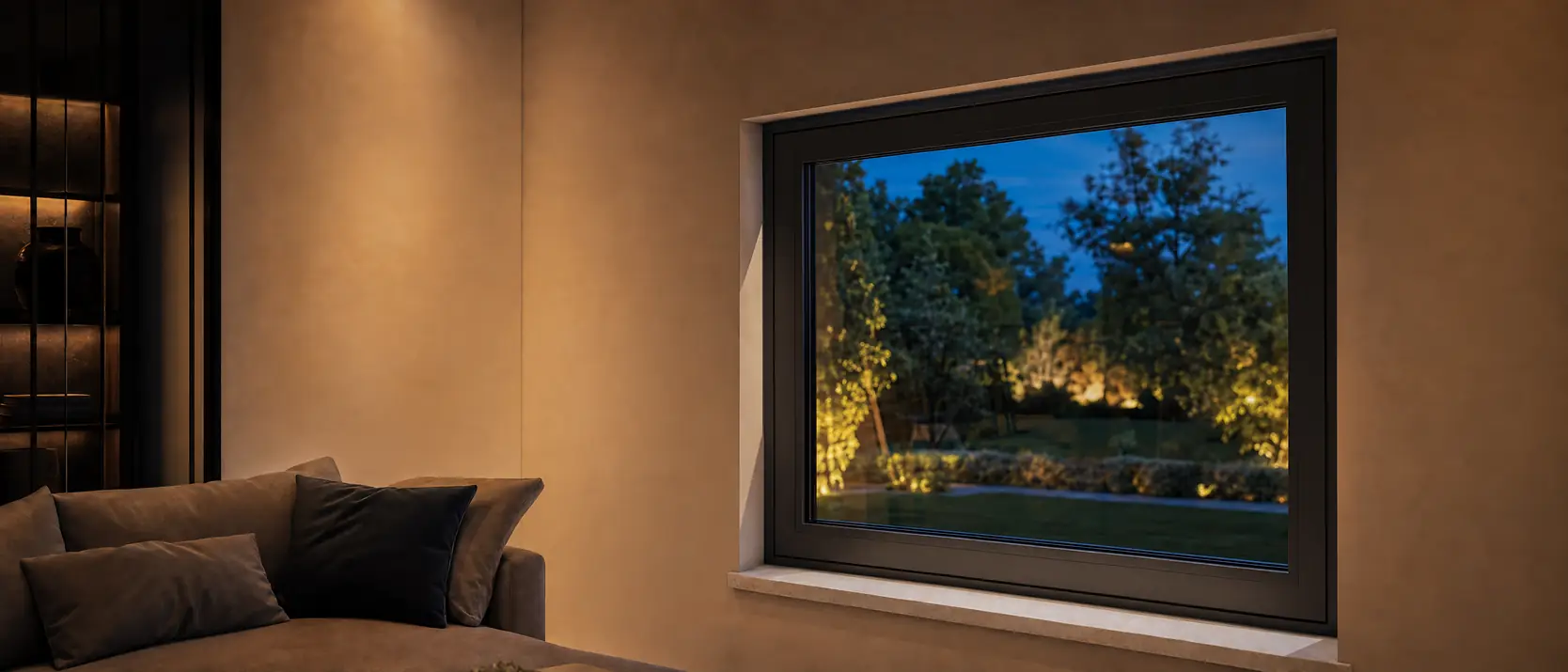
An aluminium tilt and turn window goes larger than uPVC can, and has the narrowest combined sightline of frame and sash in our whole range.
Made to measure in uPVC or aluminium, in any RAL colour. Delivery to the UK is quoted with your offer.
What comparable projects cost, by material. This is a guide price from our own quote archive — not a quote and not a final price: the amount for your own sizes, profile, glass and colour is in the quote.
for a unit of 1,000 × 1,400 mm
typically £526 to £780 per unit, excl. UK VAT and import duties The spread is too wide for a single amount; this is the range they fell within. measured on 38 quotes from our own archive
ConfigureThis is a guide price, not a quote and not a final price. The amount for your own sizes is in the made-to-measure quote, which you request through the configurator.
Choose the material and window type and enter the outside size. You see what a window of that size usually cost in our quotes. This is a guide price, not a quote: the real price for your window arrives within three working days in your made-to-measure quote.
In whole pounds, excluding VAT, import duties, delivery and fitting. Worked out with the price per m² of comparable windows in our quote archive; colour, glazing and layout can still move the amount.
Uf, frame depth and sightline come from the profile table. The corner section is the manufacturer's render of exactly this profile: for Aluprof always the same shot — closed corner, close up — and for Gealan the render of the S 9000 NL family. The maximum sash width is on every profile page.
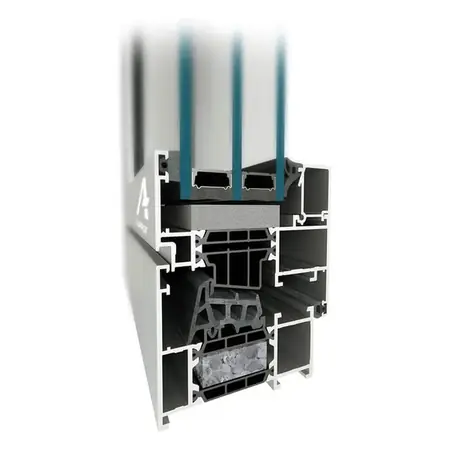
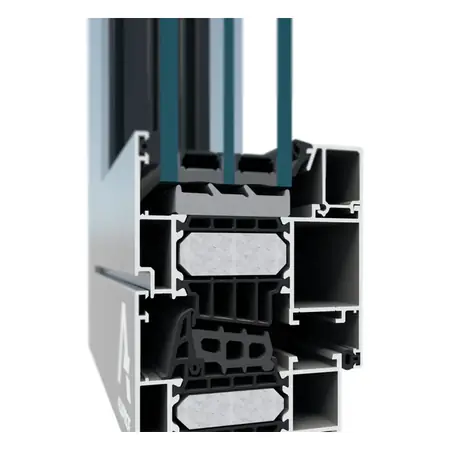
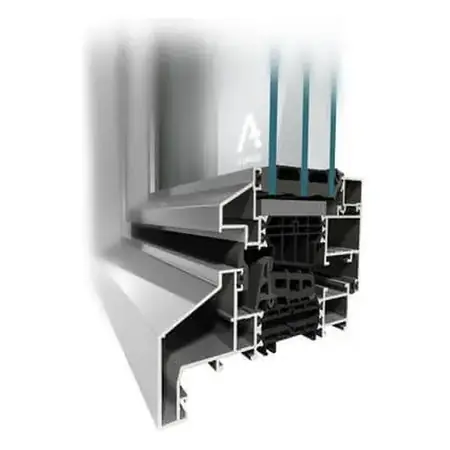
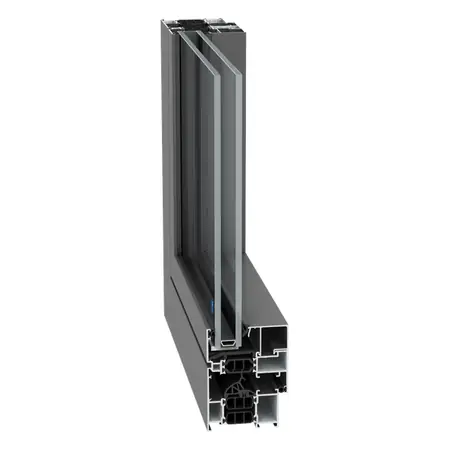
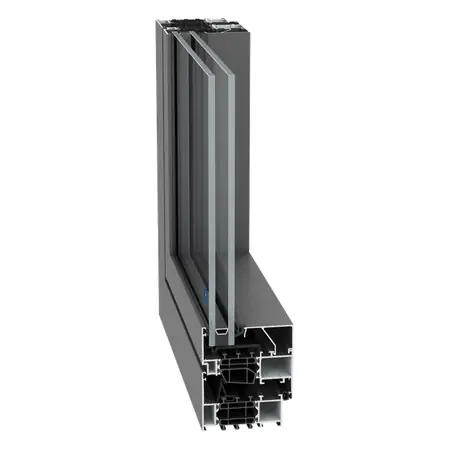
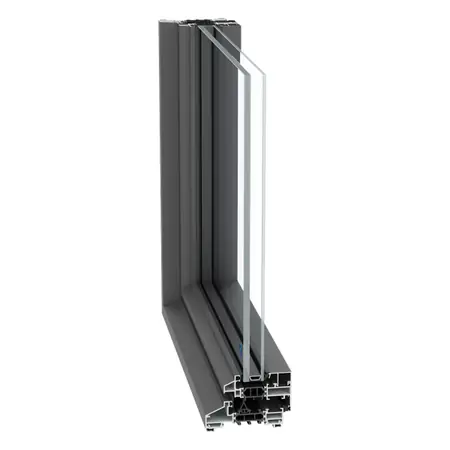
The aluminium above has a wide spread: Uf 0.57 to 1.50 W/m²K. The MB-86N at 0.57 is the best-insulating profile we carry, in any material. The Ferroline at 1.50 expressly isn't — it was chosen for its lines.
The combined sightline of frame and sash on the Aluprof windows runs from 97 mm (Ferroline) to 128 mm; the Reynaers CS 77 goes a little further at 89 mm. For comparison, the Gealan S 9000 sits at 119 mm. For a tilt and turn window in a clean, modern elevation, or where there used to be steel windows, that's the argument.
Size: up to 6,000 × 3,000 mm, with a sash up to 1,600 mm. That's 2,800 mm wider than uPVC can manage; in height the Gealan S 9000 NL actually goes further, at 3,200 mm. Aluminium is the choice as soon as the opening gets bigger than uPVC can carry — or as soon as you want a sightline uPVC can't reach.
In practice the choice often lands on the MB-79N, and on this page it's the least visible because it sits at neither extreme. It's right in the middle: Uf 0.83 with a 128 mm sightline, and at 70 mm frame depth it's the shallowest of these three Aluprof profiles. Take it if neither the lowest U-value nor the slimmest look ties your hands and the window stays under 5,000 × 2,700 mm. Above that size it drops out and you're left with the MB-86N and the Ferroline.
You're already two steps further than where the configurator starts. It first asks what the window is made of and then which profile, and that's exactly what you decide on this page. What it then asks of you is the size and the layout, the glass and the colour. For the size, measure the structural opening at three heights and three widths; the smallest figure is your size. Think about one thing that isn't a measurement: which side the hinges go. A tilt and turn sash turns open to one side, into the room, and that decides whether it clears a cupboard, a curtain or a door that opens next to it.
Two things that belong to the window and not to the profile. In England, Approved Document L asks a replacement window in an existing home for a U-value of 1.4 W/m²K or WER band B — for the whole window, not for the aluminium. Replacing windows is also notifiable building work: an installer registered with a competent person scheme, such as FENSA or Certass, notifies it, or you notify building control before the work starts. We supply, we don't install, so that's for your installer. Scotland and Northern Ireland have their own rules.
A tilt and turn window is where most of the nine choices actually do something, and two of them deserve attention on aluminium. The window handle, to start with: standard or lockable with a key. The second isn't a luxury but part of the security story — a locking handle keeps the sash shut once someone has already got through the glass. And the insect screen, because it's trickier here than people think: a tilt and turn sash opens inwards, so the screen goes on the outside and you have to be able to reach it from inside past the sash. On an aluminium sightline of 89 or 97 mm the rebate the screen sits on is narrower than on uPVC; ask about it before you order.
No form first: you watch your window take shape as you choose. The price follows in the quote, within three working days.
Because the three profiles do different jobs. The MB-86N was chosen for insulation and reaches 0.57 — the best we have. The Ferroline was chosen for its lines: 97 mm sightline, a steel look, and Uf 1.50. That's a design choice, not a shortcoming. So look at the profile, not the material.
Yes. Aluminium is powder-coated, so any RAL colour is possible, smooth or textured. uPVC works with foils and therefore has a fixed colour card. Which colours are available on your profile, the configurator will tell you.
There isn't one, and that's deliberate. You choose the MB-86N for insulation (Uf 0.57), the MB-Ferroline for looks (97 mm sightline) and the MB-79N when neither ties you: 70 mm frame depth, Uf 0.83, 128 mm sightline, up to 5,000 × 2,700 mm. Above that size the MB-79N drops out and the MB-86N and MB-Ferroline remain — they go up to 6,000 × 3,000 mm.
The structural opening in width and height, each in three places. Also note the opening direction and the frame depth: the aluminium tilt and turn profiles run from 70 to 110 mm. Go above 5,000 × 2,700 mm and some profiles drop out — the configurator sees that itself, but it helps to know beforehand.
That question isn't about the material. A security class such as RC2 (EN 1627) belongs to the complete element, including hardware and fixing. SKG stars — the Dutch rating for locks and hardware — also sit on the hardware and not on the profile. We don't list an RC class per profile: we haven't had one tested.
Yes, and it goes on the outside, because the sash opens inwards. That means you need to be able to fit and clean it from inside, past the open sash. With us an insect screen is a separate product on the same frame and not part of the window; you choose it in step 6 and the amount is shown next to it. Two per element is the maximum.
That depends on the profile: from a frame Uf of 0.57 with the MB-86N to 1.50 W/m²K. The U-value of the whole window is in your quote.
Where we have a guide price, it is on the page, not behind a form — not a quote and not a final price; the amount for your sizes is in the made-to-measure quote.
Request my quote